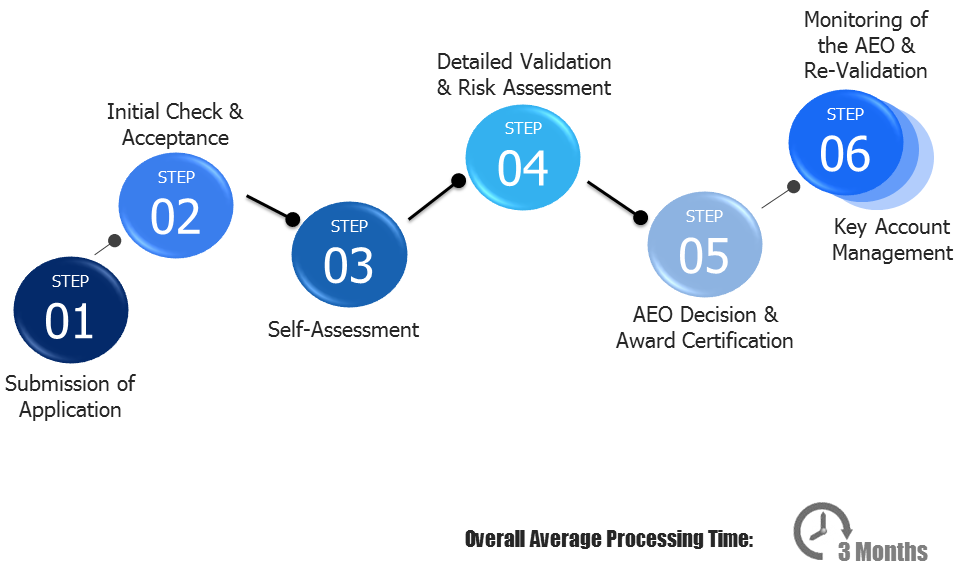
Following is the high-level six step process providing an overview of the overall AEO program:
The AEO Authorization process consists of a number of sub-processes: AEO Application Process; AEO Validation Process; and AEO Certification Process.
AEO Application Process
The application process is the initial process in the AEO Authorization process and is initiated by the AEO applicant that applies for AEO status. Dubai Customs will then validate the completeness of the application as well as performing validation on the eligibility of the applicant. The process ends either with an approved application, which then can continue to the validation sub-process, or with a denied application. In both cases the AEO applicant is advised and informed of the outcome.
AEO Validation Process
The AEO validation process aims to validate that the applicant is eligible for AEO status. This is performed using three parts or sub-processes:
- Part 1 – Self Assessment Questionnaire (SAQ)
- Part 2 – Risk Assessment
- Part 3 – Validation
Self Assessment Questionnaire (SAQ)
The first part of the AEO validation process is the SAQ-phase. The applicant will be presented to and obliged to analyze, complete and submit a SAQ, tailor-made for the specific type of business the applicant is involved in. The AEO validation team assigned composes the tailored SAQ that is appropriate for the applicant. In a meeting with the applicant, the possible facilitation benefits and their advantages will be explained as well as the business's requirements and how to manage the SAQ.
Information will be collected to consider which facilitation/benefits are most appropriate for the applicant and its activities. This initial step should provide good insight into the applicant's supply chain activities. The following subjects should be taken into account:
- The role of the business in the supply chain;
- Type of goods;
- Specific aspects of valuation;
- Classification;
- Origin of the goods;
- Security issues;
- Other regulatory requirements and,
- Reliability of the business's (financial and logistic) accounting system
Risk Assessment
After the SAQ is completed, validation team collects and assesses all available and relevant information, including intelligence information that is provided by the AEO Intelligence. This is base for the initial risk assessment. Risk assessment is necessary to find out the strengths and the weaknesses of the AEO applicant and all the areas to be covered by the validation process.
Validation
After approval from the AEO Manager, the validation is initiated. During the validation assignment, information is gathered from various sources and analyzed. Site visits are performed in order for the AEO validators to study and validate the processes, systems and the premises of the AEO applicant.
- Collect business process and system information
- Verify systems
- Understand the applicant's internal monitoring and controls
- Update the risk assessment
- Discuss and report findings
- Complete the validation
Management and Monitoring
The Management and Monitoring process consists of the Key Account Management Process, Monitoring and Evaluation Process, and Re-validation Process.
Key Account Management Process
The Key Account Manager (KAM) performs the following:
- Remain available day to day to respond to questions;
- Handle the exchange of information and reports with the AEO client;
- Arrange meetings and visits, ensuring good governance;
- Pro-actively support the AEO client with information about upcoming changes that may affect compliance, service levels, licenses, authorizations, or AEO status;
- Build networks with key institutions within and outside the agency to help the business receive correct information and foster compliance.
Monitoring and Evaluation Process
Continuous monitoring and evaluation is an essential part of AEO management and requires significant effort.
Re-validation Process
The purpose of re-validation is to ensure that the AEO remains compliant with the criteria defined by Dubai Customs. Re-validation may be planned or initiated by monitoring and management when new risks or deviations are identified. Its scope may be full, like validation, or focused on specific areas. It follows the same reports and governance as validation, except for the SAQ phase, and consists of risk assessment and re-validation.
AEO Certification Process
When AEO Management decides certification is possible, a dedicated AEO Key Account Manager (KAM) is assigned. The KAM issues the certificate and records the certification details in the CMS/ECR. The certificate is a compliance motivator that reinforces mutual trust and makes clear that AEO status is not a free benefit.
- Specific Memoranda of Understanding (MoUs) are developed and signed;
- The certificate is officially handed to the AEO applicant at a certification ceremony.